Crowd Management Technology for Stadiums and Large Events
Ask AI about this article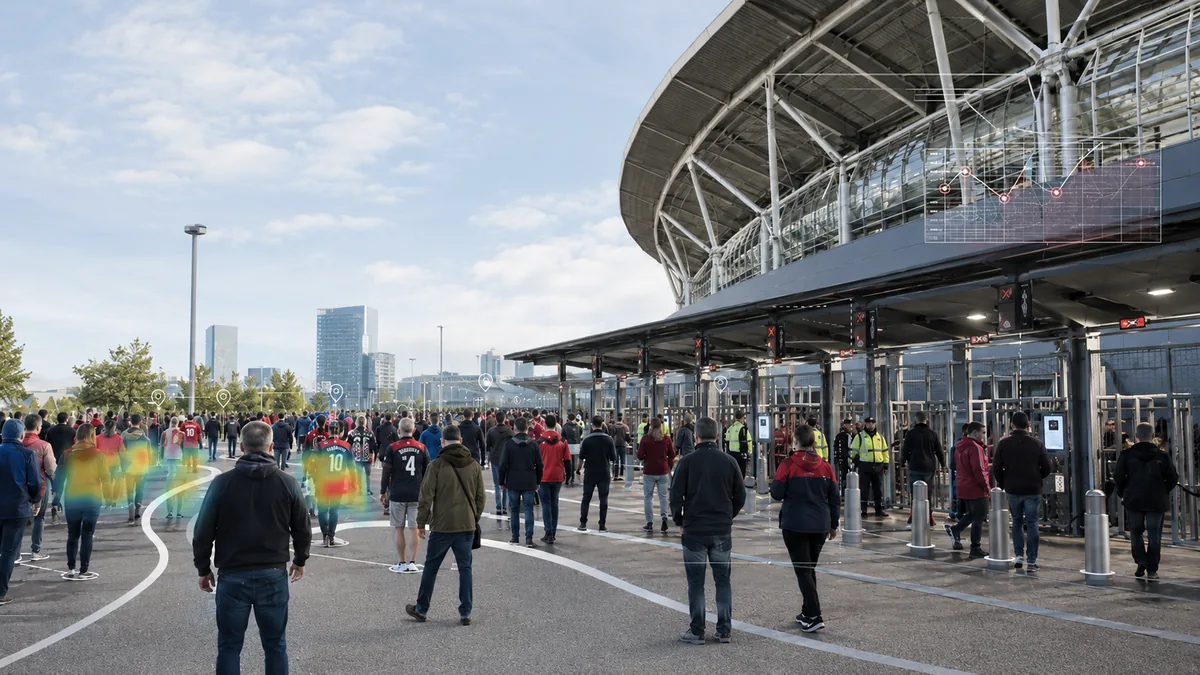

Crowd management technology has moved well beyond basic monitoring. For stadiums and large event venues, the job is not only to spot where pressure is building, but to respond quickly, coordinate teams, and keep people moving safely.
A venue may already have access to crowd data, CCTV, access control information, and reporting tools. When those systems are disconnected, teams are left working across multiple tools and manual updates. The real test is whether that information can support faster decisions across stadium operations and live event workflows.
This article looks at that next layer: how stadiums and venues should evaluate crowd management technology, operational workflows, and software capabilities that turn visibility into action.
For many venues, crowd operations used to rely mostly on staffing plans, barriers, gate procedures, and control room communication.That is changing.
Crowd management technology is increasingly becoming a crowd management software decision. Venues may already have access to crowd data, access control information, CCTV coverage, and reporting tools, but these systems often do not work together in a practical way. Teams still have to switch between tools, share updates manually, and piece together what is happening across live operations.
A stronger crowd management solution does not replace operational experience. It gives event operations teams a clearer operational structure to coordinate decisions, workflows, and incident response.

Choosing the right crowd management software is less about how many trendy features appear in a demo and more about whether the platform fits the operational reality of your venue or event.
The best crowd management platforms do more than show crowd conditions. They help teams understand where pressure is building, how movement is changing across the venue, and what needs attention first. In practice, that usually comes down to a few core capabilities: clear visibility by zone, stronger crowd flow management, practical workflows, live dashboards, and integrations that fit the wider stadium operation.
A valuable platform should help teams understand what is happening. Pressure at a gate, in a tunnel, or in a hospitality area does not create the same operational response, so a venue-wide summary is rarely enough. The closer the system reflects the venue’s actual layout through map-based operations or digital twin environments, the more useful that visibility becomes.
A build-up at a ticket barrier may require queue rearranging, while pressure in a passageway may point to a circulation issue or blocked route. In a hospitality area, the same density level could mean something else entirely. A good platform helps teams understand those differences quickly.
At one Australian stadium, real-time data on gate activity and queue build-up gave operations teams a clearer view of crowd pressure by location, helping them manage flow before bottlenecks formed.
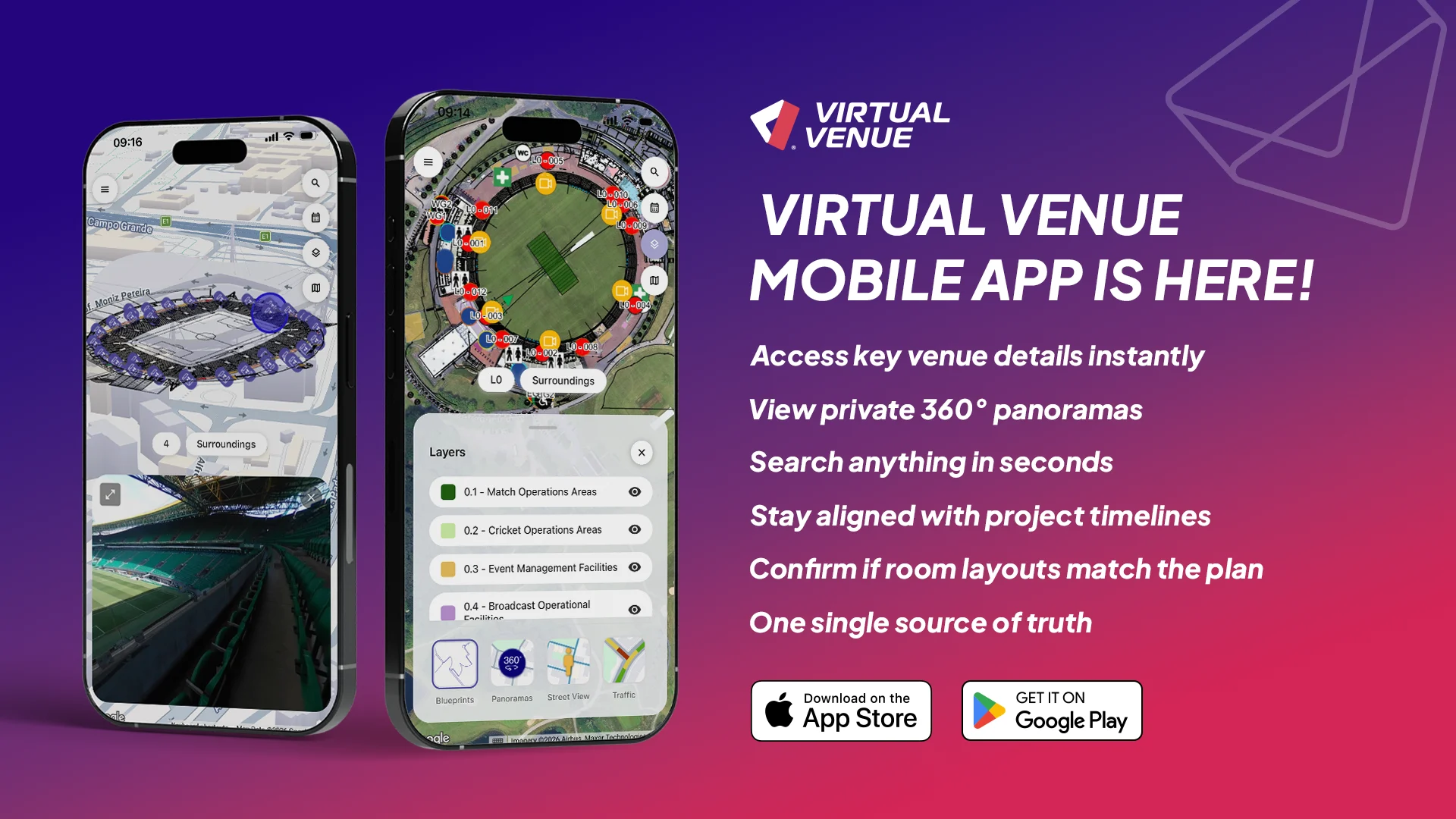
Virtual Venue delivers this through its Venue Overlay, a map-based operations layer that represents the real venue layout, with zones, access points, circulation routes, and live data in a single shared environment. This gives operations teams the spatial visibility they need to distinguish a gate bottleneck from a passageway blockage and respond accordingly.
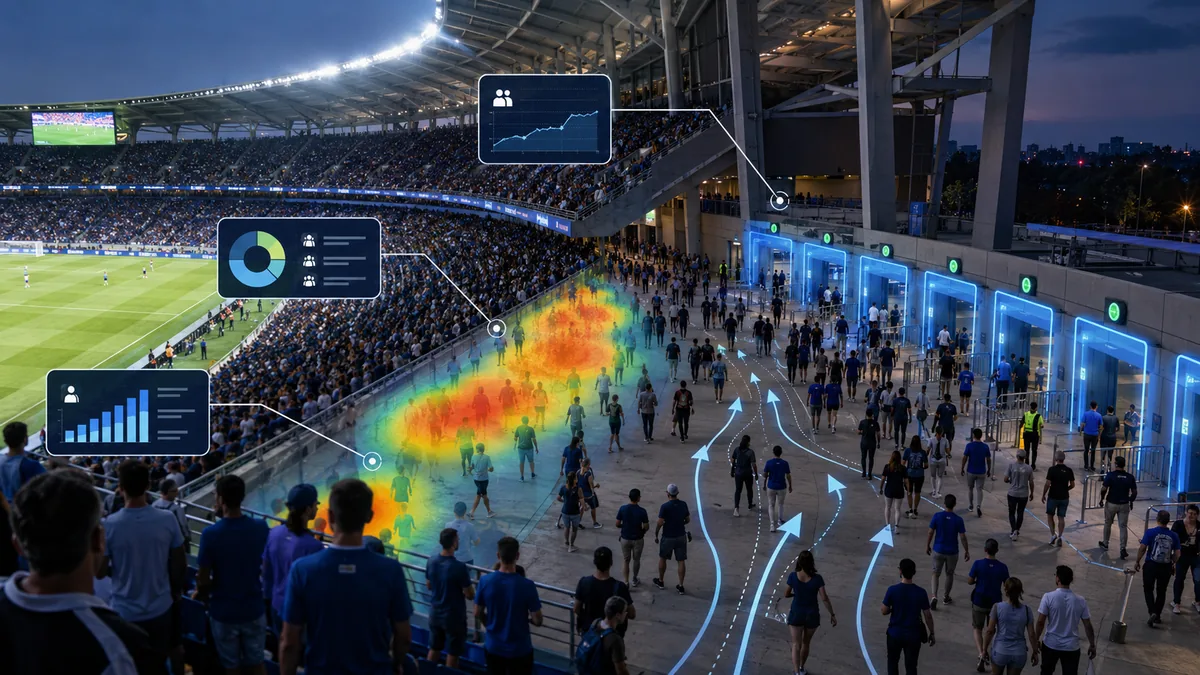
A strong crowd management system should support crowd flow management, not just basic analysis.
In practice, that means helping teams plan and adjust how people move through access points, circulation routes, and high-density areas.
For venues like stadiums, this matters because crowd pressure is rarely static. Arrival patterns shift, gates perform differently than expected, and circulation routes can become constrained very quickly. In reality, crowd pressure does not begin only inside the stadium bubble. It often starts with transport routing, drop-off patterns, parking flows, and how fans arrive on site.
That is why mobility planning should sit alongside crowd flow planning, even if it starts outside the venue perimeter.
FC Barcelona’s innovation team described a digital twin stadium environment that mapped accesses, floors, stairs, lifts, and connected devices so the club could analyse crowd flows, compare event-day actions, and improve movement planning around the stadium.
Virtual Venue supports crowd flow management through its map-based Designer, which allows operations teams to plan flows, define zones, and model circulation routes before event day. When real-time data is needed, the platform's API & System Integrations allow teams to connect external data sources, including traffic feeds, sensor data, and access control systems, directly into the operational environment.
This is where basic monitoring tools usually fall short.
When an issue appears, the system should make it easier to log it in context, assign responsibility, track progress and support incident management workflows with a clear operational record. If the response still depends on side conversations and disconnected follow-up, the platform is only solving part of the problem.
At the Oakland Athletics (American professional baseball team based in Oakland,California) stadium operations teams used a digital incident workflow to document significant incidents on scene instead of relying on Excel, notepads, and radio follow-up, making it easier to capture issues clearly and maintain an operational record as events unfolded.
Virtual Venue's Site Visit Reporting and Incident Management capabilities are built precisely for this. Teams can log issues directly in the venue map context, assign ownership, track resolution, and generate a structured operational record, without relying on radio follow-up or disconnected tools.
Dashboards matter, but only when they help teams make faster decisions. A control room does not need dozens of screens for the sake of “better” visibility. It needs a clearer view of crowd pressure, access activity, open issues, and live operational priorities across stadium operations. The best dashboards support decision-making in the moment rather than simply displaying information.
Maple Leaf Sports & Entertainment (MLSE), one of Canada's leading sports and entertainment organizations, has described using dashboards in its Integrated Operations Center to support real-time decisions across security, medical incidents, and venue operations.
Virtual Venue's Real-time Dashboards give event operations teams live visibility across KPI, crowd conditions, open action points, and venue activity, all in one place. For stadium crowd management, this means the event operations centre has a single operational picture rather than switching between disconnected systems for real-time crowd monitoring.
Most venues already work with a mix of systems, from access control and ticketing to reporting tools and mobility data. A platform becomes much more useful when it works with those systems rather than sitting apart from them. The goal is to connect crowd-related information into one clearer operational coordination process across venue operations systems.
At Hard Rock Stadium, G4S (private security company) described an integrated security setup that brought together access control, identity management, video surveillance, and incident management through a central operations hub. A clear case of why integrations matter in venue operations: crowd-related decisions become much easier when key systems are connected rather than managed in isolation.
Virtual Venue is built as an open platform. Its API & System Integrations layer allows organisations to connect the tools they already use, from ticketing and access control to sensor networks and third-party reporting systems, into one venue operations software environment. This is what turns a stadium operations platform from a standalone tool into the connective layer across multi-stakeholder coordination.
Not every platform is built to solve the same problem. Some tools are designed to measure crowd conditions clearly. Others are built to support operational response, coordination, and live event workflows as well. Understanding that difference makes it easier to assess what your venue actually needs.
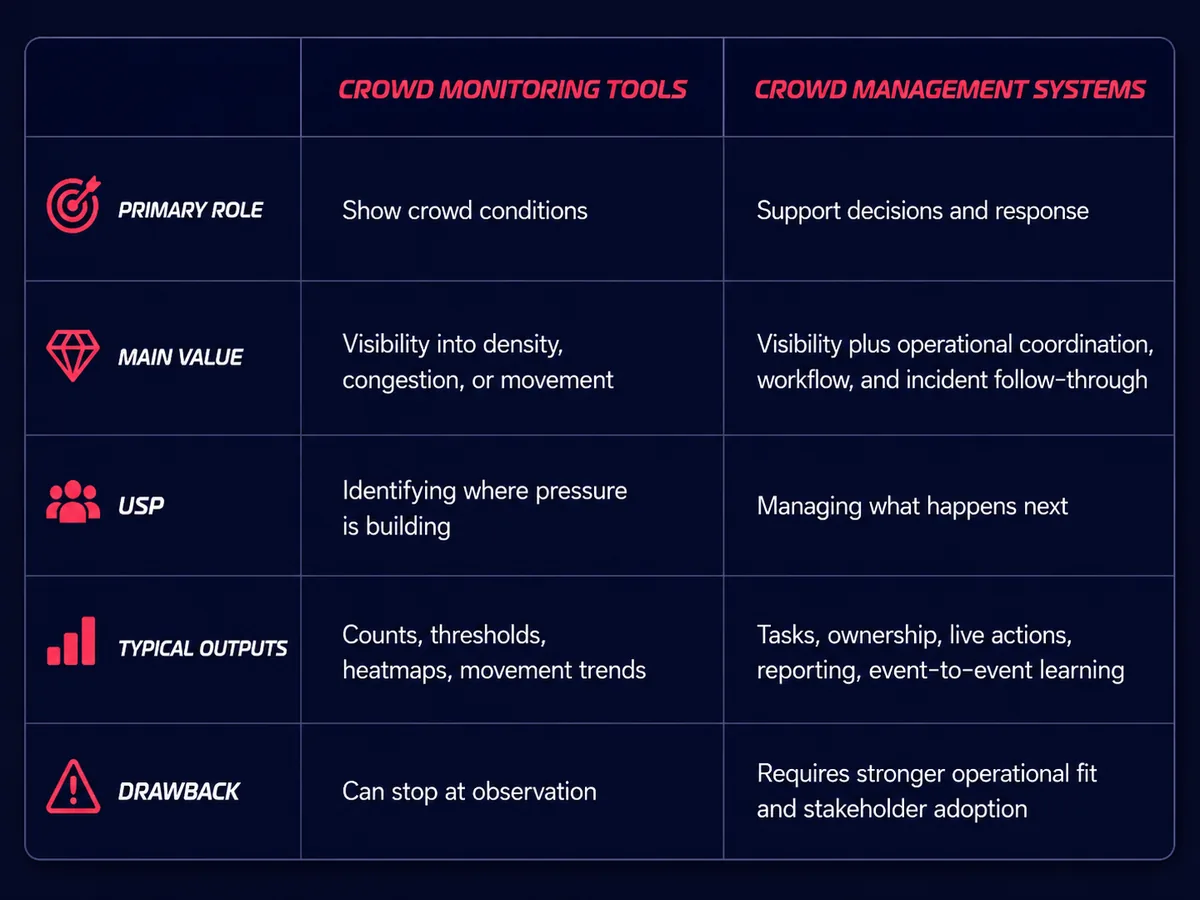
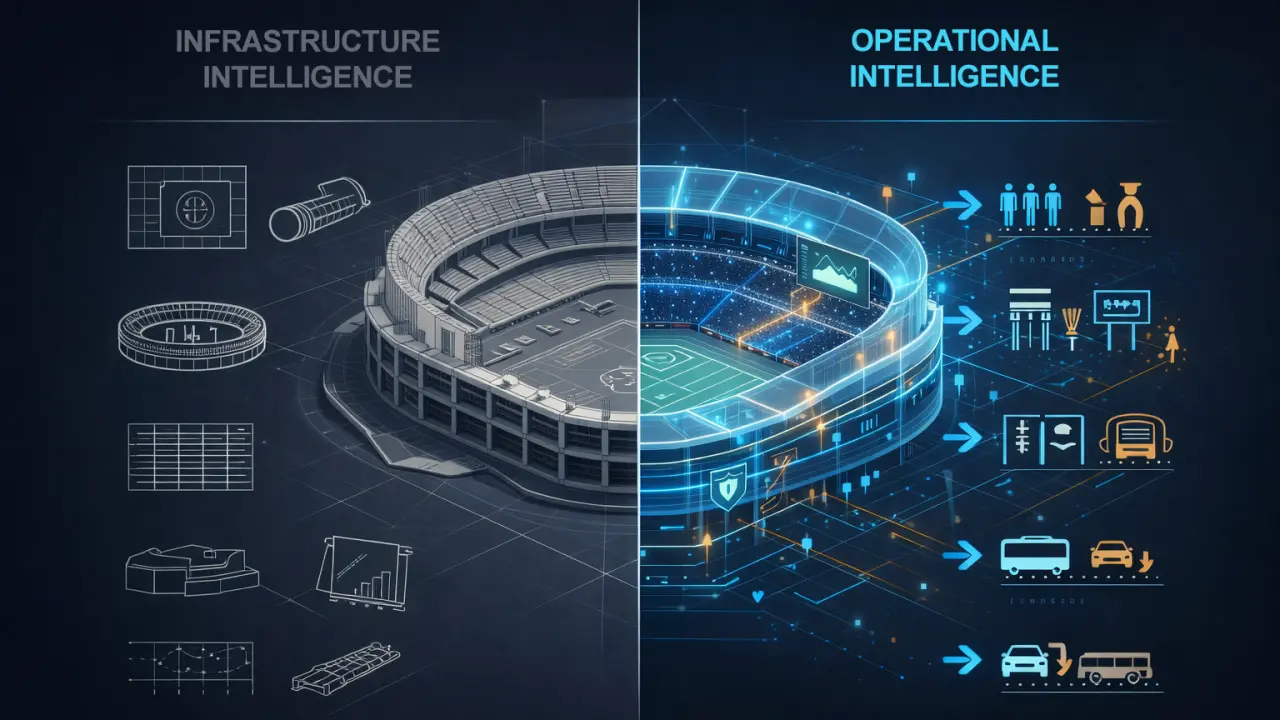
There are many crowd monitoring and tracking solutions on the market, that’s clear. Some of them are useful, but it is not the same as crowd management. A strong crowd management system goes further. It connects venue layout, live visibility, operational workflows, and reporting into one operational process, often through map-based operations or digital twin environments. It helps teams move from insight to action, not just from signal to screen.
If you want to explore the data layer behind that visibility in more detail, our related article on How IoT Sensors Are Impacting Event Crowd Management looks more closely at how sensors support smarter crowd operations.
A lot of crowd technology projects become more complicated than they need to be because teams choose tools for the wrong reasons.
One of the most common mistakes is choosing a platform because it visualises crowd conditions well, without asking whether it supports operational response and live event workflows. A heatmap may look impressive, but if the system cannot help teams assign actions, track issues, then it leaves the hardest part unresolved.
Another mistake is treating crowd management as a standalone stream of information. In reality, crowd operations are closely linked to wider venue operations, including access control, transport, ticketing, staffing, and incident management. If the platform cannot work across those realities, teams will still end up coordinating through patchy processes.
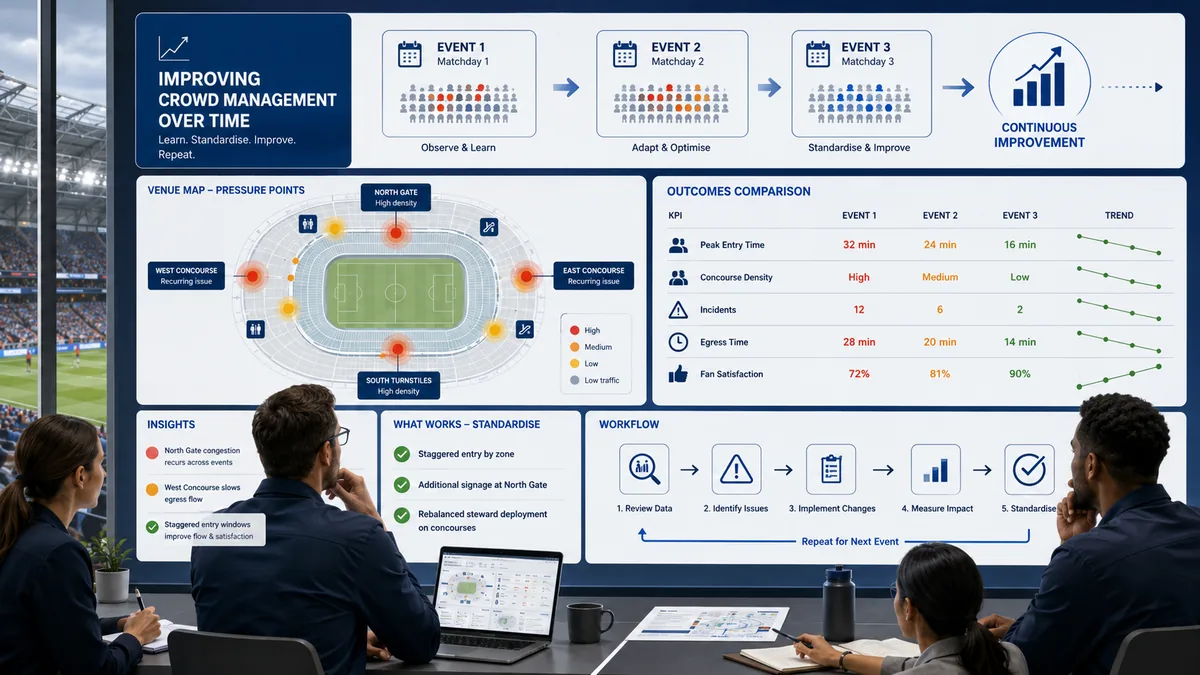
A third mistake is focusing only on the next event. The long-term value of crowd management technology comes from helping teams standardise what works, compare outcomes, and improve over time.
When evaluating platforms, it helps to start with your own operational friction first. Where do teams currently lose time? Where does communication break down? Which pressure points appear repeatedly across matchdays or event days? Those answers are usually more useful than a generic checklist.
Virtual Venue approaches crowd management through operational coordination, not just monitoring. The platform brings together venue layout, live visibility, operational workflows, and team coordination into one shared environment, so everyone works from the same reference point during planning and on event day.
At its core, Virtual Venue is a map-based operations platform, a digital twin stadium environment where zones, access points, circulation routes, and operational issues are all managed within the same spatial layer. This gives organisations the operational visibility to understand what is happening and where, without switching between disconnected systems.
For crowd-related workflows, the platform's Site Visit Reporting and Incident Management tools make it easier to log issues in venue context, assign responsibility, and track progress through to resolution.
Real-time Dashboards give the event operations centre live visibility across KPI and crowd conditions, integrating data from sensors, access control, and third-party systems via the platform's open API layer.
The result is a venue operations software platform that supports the full operational workflow: from pre-event crowd flow planning through live stadium crowd management to post-event reporting, all in one place, across all stakeholders. For stadiums and other venues, the challenge is how to choose event crowd management software that helps teams respond faster, coordinate more clearly, and improve event delivery over time.
Looking at crowd management technology for your venue? We can show you how Virtual Venue can support your eceb
Talk to Our TeamCrowd management technology refers to the systems and tools that help stadiums and venues understand crowd conditions, manage movement, coordinate live operational responses, and improve future event planning.
Crowd monitoring focuses on visibility, such as density, occupancy, or movement. Crowd management software goes further by helping teams plan flows, coordinate operational workflows, assign responsibility, and track outcomes.
Stadiums should look for software that supports zone-based and real-time visibility, crowd flow planning, operational workflows, integrations with existing systems, and multi-stakeholder coordination.
Virtual Venue helps stadium and venue teams manage crowd operations in one shared platform. It gives teams a digital twin of the venue, live operational visibility, and tools to coordinate actions, track issues, and work from the same information during planning and live event delivery.
Integrations matter because crowd operations depend on more than one source of information. A strong venue operations platform should work with the systems venues already use rather than creating another silo.
Behavioral analytics for crowd management can help identify repeat bottlenecks, detect unusual movement patterns, and improve operational visibility, and support better event planning over time.
Platforms with real-time crowd monitoring capabilities, such as Virtual Venue's Real-time Dashboards, make this kind of venue intelligence actionable during live operations, not just in post-event review.
A digital twin in crowd management is a virtual representation of a stadium or venue that helps teams monitor movement, manage operational workflows, and improve coordination during live events.
Latests from our Blog
See Virtual Venue in action
Streamline planning, enhance execution, and stay in full control with Virtual Venue.
Book a demo today and see how we can help optimize your events.
Get in Touch
All Rights Reserved © Virtual Venue


















.svg)
.svg)
